

By Mike Mathers, RCC | Addiction & Trauma Counsellor
Being sober curious means exploring your relationship with alcohol with interest rather than judgement. You don't need to identify as an "alcoholic," hit "rock bottom" or even have a drinking problem to begin. The goal isn't necessarily sobriety, although some people discover along the way that they'd rather not drink at all. The point isn't to arrive at a predetermined destination, but to develop greater awareness, flexibility and choice about when, why and how much you drink.
This is also the philosophy behind a book I'm writing called Curious AF.
After years of working with people struggling with addiction, trauma and shame, I've become increasingly convinced that curiosity is one of the most important skills we can develop. Not because it gives us all the answers, but because it helps us become less certain of the harsh judgements we make about ourselves.
Curiosity is the antidote to the false certainty of shame, and often the first step toward genuine self-compassion.
What does sober curious mean?
Being sober curious is about giving yourself permission to examine your relationship with alcohol without deciding in advance what you're supposed to discover. It's an opportunity to step outside your usual habits and notice how drinking fits into your life, what you enjoy about it, and whether it's contributing to the life you actually want.
You may have encountered the idea through the broader sober curious movement or initiatives like Dry January and Sober October. Taking a month off can be a useful experiment, but you don't need a calendar event or a commitment to abstinence to begin.
Sometimes the changes are surprisingly small. Maybe you notice that you've developed a habit of pouring a drink at 6 p.m., whether you particularly want one or not. Or perhaps you decide to skip that second glass and see how you feel the next morning. The point isn't necessarily to change the behaviour immediately, but to become more aware of the choices you're making, including the ones that have become so automatic they no longer feel like choices.
Where that curiosity takes you is entirely individual. Some people discover they enjoy drinking less, others find they prefer not drinking at all, and some become more comfortable with their existing relationship with alcohol. What's important is developing the awareness and flexibility to make choices that genuinely support your well-being.
The sober curious movement is gaining attention beyond counselling offices. The National Institute on Alcohol Abuse and Alcoholism (NIAAA) has explored how younger Americans are reconsidering their relationship with alcohol, reflecting a broader cultural conversation that is also taking place in Canada.
Grey area drinking
Grey area drinking describes the space between having no obvious problems with alcohol and experiencing serious consequences from it. Your drinking might not be causing a crisis, but something about it isn't quite working for you either.
It's not a clinical diagnosis. Alcohol use exists along a continuum, and there isn't a clear dividing line between people who have a problem and those who don't. More importantly, you don't need to meet the criteria for an alcohol use disorder to recognize that drinking might be costing you something.
Those costs can be subtle. Maybe you're sleeping poorly, feeling less energetic, noticing changes in your mood or finding yourself less present with the people you care about. And some consequences aren't immediately noticeable. Canada's Guidance on Alcohol and Health, developed by the Canadian Centre on Substance Use and Addiction (CCSA), highlights how alcohol-related health risks increase with consumption and how reducing drinking can lower those risks.
You don't have to convince yourself that your drinking is a problem before considering a change. Sometimes it's enough to get curious about whether your life might be better with a little less alcohol in it.
What your drinking is doing for you
When someone first comes to see me, one of the questions I often ask is, "Tell me all the good things about your drinking." People usually expect me to focus on what's going wrong. Instead, I want to understand what's going right, because that tells us something important about why alcohol has become part of their life.
Alcohol serves a purpose. Sometimes it's simply enjoyable. Other times it provides relaxation, connection, confidence, relief from stress or an escape from difficult emotions. It can be a pretty effective short-term solution, which helps explain why people keep returning to it, even when it starts creating problems of its own.
Take that glass of wine at the end of a long shift. It might be doing several jobs at once: marking the end of work, easing tension and providing a few moments that belong entirely to you. Understanding those different functions matters because there may be other ways to meet those same needs, without necessarily giving up everything you enjoy about drinking.
In my work, I often focus on three interconnected areas of well-being: developing the skills to navigate difficult emotions, building meaningful connections with others, and cultivating a sense of meaning and purpose in life.
This is the foundation of what I call the Wellness Evolved Quality of Life Enhancement Model. Rather than focusing exclusively on reducing or eliminating alcohol, we work on improving the quality of your life so alcohol has less of a job to do.
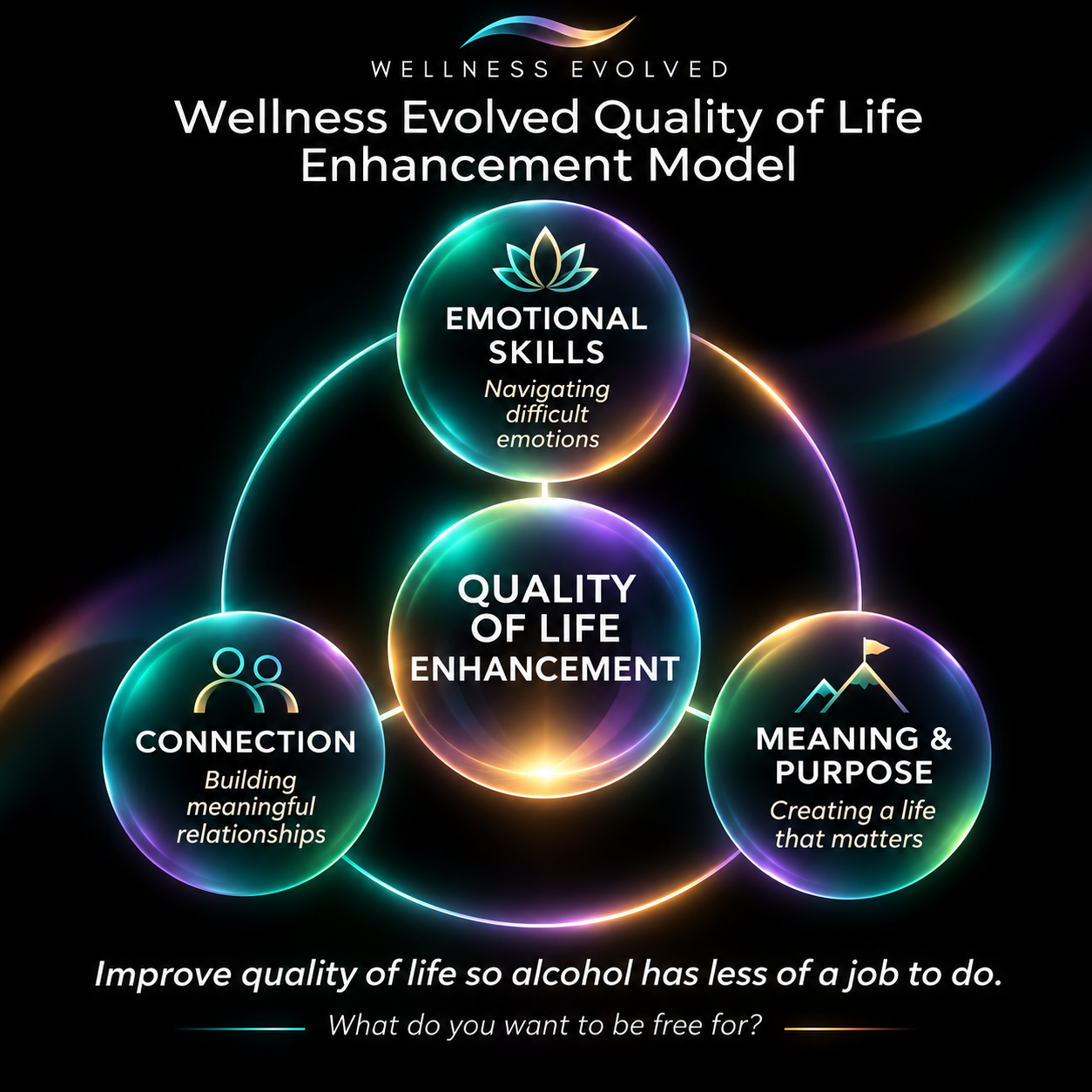
Ultimately, it's not just about what you want to be free from, but what you want to be free for.
If you'd like to explore this approach further, I explain the Quality of Life Enhancement Model in this short video:
Watch: The Wellness Evolved Quality of Life Enhancement Model
Curiosity instead of shame
Curiosity is one of the most important skills we can develop, particularly when it comes to navigating uncomfortable emotions. Shame tells us there's something wrong with us and treats that conclusion as fact. Curiosity introduces a little uncertainty into that story. Maybe there's more going on here than we realize.
Rather than immediately judging yourself for reaching for another drink, curiosity helps you notice what's happening without rushing to explain, fix or condemn it. Interestingly, this shift in attitude can take some of the intensity out of difficult emotions, making them easier to experience without automatically trying to escape them.
The goal isn't to eliminate discomfort. It's to change your relationship with it so that you have more freedom in how you respond.
And you don't have to start with self-compassion. For many people, curiosity is how they gradually get there. After all, curiosity is the antidote to the false certainty of shame.
If you'd like to explore this further, here's a link to a podcast where I spoke more about curiosity instead of shame and its role in addiction recovery.
Try This: PAWS — Point at What Sucks
Here's a simple exercise I call practicing the PAWS by:
Pointing at What Sucks!
The next time you notice yourself wanting a drink, using a substance or getting high, take a moment to PAWS & get curious AF about what's happening in your life. Not to judge yourself or talk yourself out of anything, but to notice what might be missing or what needs aren't being met.
Pay particular attention to three areas:
- Emotions: Are there difficult feelings you're struggling to navigate, or something you're trying to escape?
- Connection: Are you feeling lonely, disconnected or craving depth in relationships?
- Meaning and purpose: Is there something missing in your life that gives you a sense of direction, satisfaction or fulfilment?
You don't need to figure everything out, and you certainly don't need to change your entire life overnight. The point isn't to fix or solve anything in that moment. It's to recognize what might be missing in your life, particularly the values you aren't fully living, and use that awareness to guide your choices toward what matters most to you in the long run.
Instead, consider whether there's something you could do to meet one of those needs just 1% better. Maybe it's reaching out to a friend, taking a few moments to sit with an uncomfortable feeling rather than escaping it, or doing something small that gives your day a greater sense of purpose.
And here's the important part: celebrate the awareness itself as a victory! Even if you still have that drink, you've practised noticing something about yourself rather than simply reacting on autopilot.
You can't interrupt a pattern you haven't learned to recognize. Every time you catch yourself in that familiar cycle, you're developing the awareness that makes change possible. Recognizing the pattern is progress in itself, even before you do anything differently.
Keep paying attention. Gather more information about what you're feeling, what you need and what actually improves your quality of life.
Over time, those small moments of curiosity and intentional action can help you build a life where alcohol has less of a job to do.
How to drink less alcohol: ways to experiment
Once you start recognizing your drinking patterns, you might get curious about changing a few of them. You don't need a perfect plan or a commitment to sobriety. Think of these as small experiments in improving your quality of life, with no passing or failing.
- Track your drinking: Keep a record of how much, when and why you drink for at least two weeks, ideally longer. Include alcohol-free days. The goal isn't to judge yourself, but to recognize patterns you might otherwise miss.
- Try zebra striping: Make a simple rule: no two alcoholic drinks in a row without a glass of water or another non-alcoholic beverage in between. It creates a pause to consider whether you actually want another drink. Water doesn't cancel out alcohol's effects.
- Use PAWS (Point at What Sucks): Get curious about what alcohol might be doing for you. Are you struggling with difficult emotions, feeling disconnected or missing a sense of meaning and purpose?
- Experiment with 1% improvements: Try having one less drink, choosing an alcohol-free occasion or finding another way to meet a need alcohol has been meeting, provided it's medically safe.
- Notice and celebrate: Pay attention to changes in your sleep, mood, energy and relationships. If things don't go as planned, get curious about why. There's no failure if there's learning.
Want to explore this a little further? I've created a free Curious AF Drinking Tracker to help you put these ideas into practice. It includes a two-week drinking diary, PAWS reflections and simple exercises to help you recognize patterns and make small changes that matter.
This is also a tool I use in my therapeutic work. While you can absolutely explore these exercises on your own, working with a counsellor can help you recognize patterns you might otherwise miss, develop new skills and make more meaningful changes to your quality of life.
A medical note belongs here. If you drink heavily or daily, don't stop or cut back suddenly on your own. Talk to a doctor first, because alcohol withdrawal can be dangerous and, in its most severe form, fatal. Shaking, sweating, vomiting or significant anxiety after you cut back are reasons to get medical advice promptly. Medical care and counselling can run alongside each other.
When curiosity leads to wanting support
Getting curious about your drinking can reveal patterns you hadn't noticed before. But recognizing those patterns is only part of the process. Sometimes having someone help you make sense of what you're learning and develop the skills to make meaningful changes can make a real difference.
At Wellness Evolved, my approach to addiction counselling focuses on improving your quality of life, not simply reducing alcohol consumption. I work with people across the entire spectrum of alcohol use, including those who aren't sure they want to change anything. You don't need a diagnosis, a commitment to abstinence or even a clear goal to get started.
If you're concerned about someone else's drinking, I also offer Invitation to Change coaching to help families and friends develop practical skills to encourage positive change while protecting their own well-being. Your loved one doesn't need to participate for you to benefit.
Sessions are available virtually throughout BC or in person in West Vancouver. If you'd like to explore whether this approach is a good fit, contact me to arrange an introductory consultation.
This article provides general information, not a diagnosis or individualized clinical advice. Speak with a qualified healthcare professional about your specific circumstances.
Frequently Asked Questions
What does sober curious mean?
Sober curious means exploring your relationship with alcohol with interest instead of judgement, without needing a label, a diagnosis or a commitment to quit. The goal is more awareness and choice about your drinking.
Does sober curious mean I have to quit drinking?
No. Sober curious is about awareness and choice, not a required outcome. Some people stop completely, some drink less, and some decide their current pattern suits them. Each of those can be a considered decision.
How do I know if I'm a grey area drinker?
If your drinking isn't a crisis but isn't quite working either, you may be in the grey area. Look at sleep, energy, mood and relationships. A noticeable cost in any of them is a good reason to get curious.
How can I drink less alcohol without quitting?
Start by noticing when and why you drink, then experiment with fewer drinks or alcohol-free occasions where that is medically safe. Treat the results as information. If you drink heavily, talk to a doctor before cutting back.
Can I see a counsellor if I don't think I have a problem?
Yes. Counselling is useful for people who are questioning their relationship with alcohol, even if they are unsure whether they want to change anything. You can begin while you are still deciding.
Is it safe to stop drinking suddenly?
It depends on how much and how often you drink. If you drink heavily or daily, stopping suddenly can be dangerous because of withdrawal. Speak with a physician before significantly reducing or stopping, and get prompt medical advice if shaking, sweating, vomiting or intense anxiety appear.